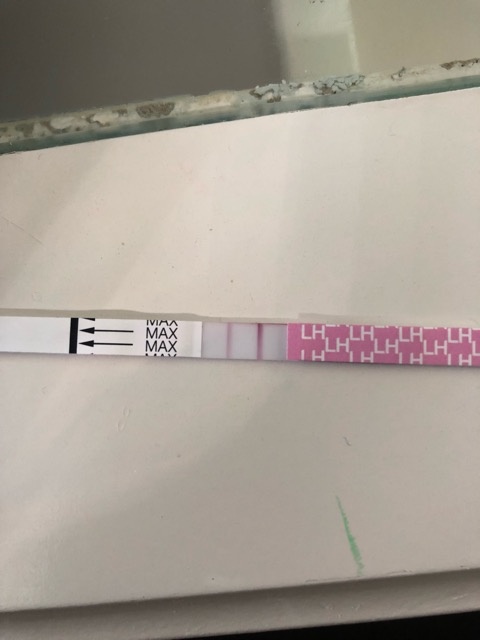
I stared at the test strip for five minutes. Was that a line? A dark line? A line that's darker than the control line? What does "darker" even mean when both lines are pink and I'm colorblind-adjacent before my first cup of coffee?
It was 6:15 AM. I'd been tracking my cycle for four months, using BBT and cervical mucus, and I thought I had a pretty good handle on my ovulation timing. But I'd never used an ovulation predictor kit (OPK) before. My friend Priya swore by them. "Just pee on the stick at 2 PM," she said. "When the test line is as dark as the control line, you're about to ovulate. Simple."
It was not simple.
The First Test
I bought a box of 20 test strips online for $18. Cheap ones, not the fancy digital kind. The instructions said to test between 10 AM and 8 PM, avoiding first morning urine. I chose 2 PM because that's when Priya said to test, and also because that's my lunch break.
Day 15 of my cycle. I peed in a cup, dipped the strip for 5 seconds, laid it flat, and set a timer for 5 minutes. Then I paced my apartment. I checked it at 3 minutes. No line. I checked it at 4 minutes. Faint line. I checked it at 5 minutes. Faint line, definitely lighter than the control.
Negative. Not ovulating yet.
I felt weirdly disappointed. Like I'd failed a test I didn't even need to take. My mucus was already egg-white quality. My BBT was still low. I knew ovulation was coming. But the strip didn't confirm it, and somehow that mattered.
The Positive
Day 16, 2 PM. Same routine. Pee, dip, wait, pace.
This time, the test line showed up immediately. Dark. Bold. Almost aggressively pink. I held it next to the control line and squinted. Was it darker? The same? Slightly lighter? I took a photo and texted it to Priya. She replied in 30 seconds: "That's positive. Ovulation in 12-36 hours."
I felt this weird rush of validation. Like my body had passed a test. All those months of tracking mucus and temp — and now a plastic strip agreed with me. My ovulation was happening on day 16, just like my data predicted.
The Reality
OPKs detect the LH surge — the hormone spike that triggers ovulation. A positive test means your LH is elevated, which typically happens 24-36 hours before the egg releases. It's predictive, not confirmatory. Unlike BBT, which confirms ovulation after it happens, OPKs tell you it's about to happen.
But they're not perfect. Some women have short LH surges and miss them if they don't test at the right time. Others have elevated LH throughout their cycle, causing false positives. And the "test line as dark as control line" rule? It's subjective. I've seen strips where the lines were basically identical and I couldn't tell if it was positive or not.
I used OPKs for three cycles, then stopped. They were useful for learning my pattern, but once I knew it — day 16, every cycle — I didn't need the confirmation anymore. My mucus and BBT tell me everything I need to know.